Start with What?
The Most-Watched Bad Idea in Marketing
Why did Simon Sinek get so famous?
One answer: he tapped into a universal truth that people, not just marketers, could easily grasp. He then linked his framework to biology, claiming near-irrefutable evidence that humans evolved to think 'why' first.
The real answer is less flattering. Sinek's audience was primed to eat up anything that neatly packages complex buying behavior into a single sentence. Let’s give the devil his due: the framework is ingenious precisely because anyone can repeat it. Start with Why.
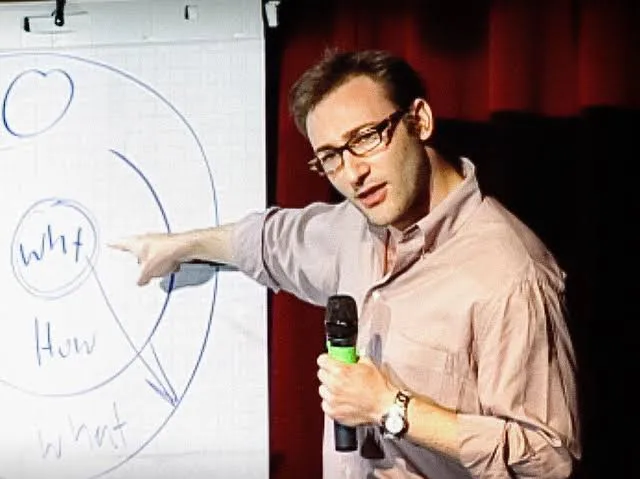
For those of you not familiar with Sinek, first of all congrats, a recap of his idea is neatly produced in his viral Ted Talk. In this Ted Talk, Sinek draws three concentric circles; the Golden Circle. On the outside, What you do. In the middle, How. At the center, Why. The Why is your purpose, your reason for being. Most companies communicate from the outside in: here's the product, here's what it does, please buy it. Great companies do the reverse. They start at the center and work out. Apple doesn't sell you a spec sheet; it sells you the belief that the status quo is worth challenging, and the laptop is almost an afterthought. People don't buy what you do, goes the line. They buy why you do it.
Not convinced? Well, you should be because, Sinek says: “ None of what I’m telling you is my opinion. It’s all grounded in the tents of biology. Not psychology, biology.” This is again a brilliant move that makes it impossible to disagree with him. It's a beautiful story. It's also total bullshit. There’s no serious neuroscience under "we evolved to think why-first."
But really you don't even need the neuroscience to see it. Try a quick exercise. Wherever you're sitting, presumably your (home) office , look at the objects around you, name the brand, and tell me the 'why' of that brand. I can tell you ZERO of the whys of anything I can see in my house. My Samsung TV and phone. My Pergamino coffee mug. My Sony headset. My Logitech keyboard and mouse. My Coach backpack. My Babolat padel racquet. I have no idea why any of these brands do what they do. Their 'purpose' is a total mystery. Yet I enthusiastically bought everyone. And those are the big-ticket items. It gets worse once you start looking in your fridge.
Nick Asbury devotes a chapter of The Road to Hell to taking Sinek apart, and it's worth borrowing all of it. Start with the circle itself. Consultants runs on proprietary diagrams like brand onions, brand pyramids, brand houses, the occasional brand doughnut. Sinek’s contribution was three circles, one inside the other (Sinek is after all a former consultant). Asbury's verdict is that this makes Sinek a rhetorician, and a skilful one at that, but not a thinker. Look at his heroes. The Wright brothers won the race to powered flight, Sinek says, because they wanted it more; a stronger why. It's the logic of the football pundit explaining that the winning side simply wanted it more. It flattens a story of incremental engineering into a matter of desire and skips the inconvenient truth: the Wrights wanted to get rich off the invention and largely failed, which is why you've never flown Wright Airlines.
Start with why doesn't sharpen a brand. It dilutes it down to something so generic that you are no longer sure if you’re buying coffee or an enterprise SaaS. Byron Sharp will tell you that distinctiveness is how brands grow. Sinek will have you marching the other way, towards sameness.
None of this is really about Sinek. He was an adman with a good diagram and a better stage presence. He became mega famous and rich off the back of the purpose movement that he was leading by giving it a catchphrase and a framework. Good for him! The question worth sitting with is how a story that collapses the moment you look around your own kitchen went unchallenged for over a decade.
Here's my hypothesis. Most marketers are self-taught, if they're taught at all. And self-taught marketers reach for whatever goes down easily, no patience for data, no stomach for complication. Offer them Sinek's feel-good Start with Why or Byron Sharp's Double Jeopardy law, and the feel-good story wins. Less friction.