The 22 Laws, Revisited
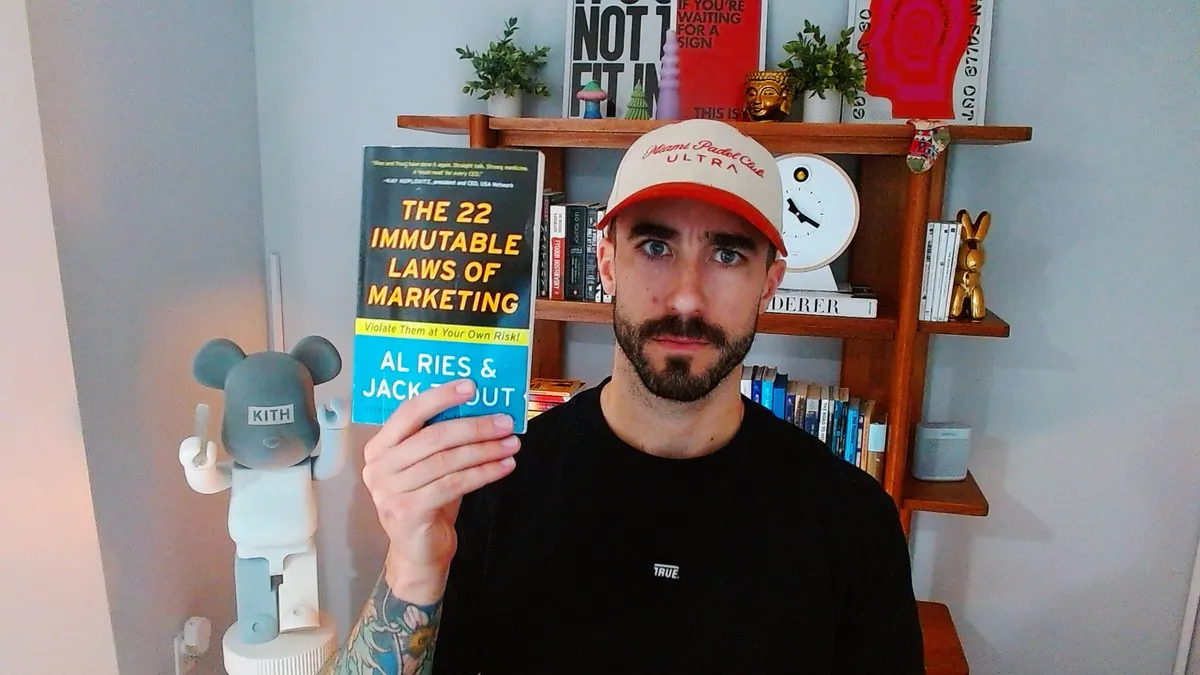
I was born in 1992. A year later, Al Ries & Jack Trout published their seminal The 22 Immutable Laws of Marketing. This was one of the first marketing books that I read, and it had a profound effect on me. The part about differentiation and needing to own a category made complete sense.
Fast forward to today. I'm out of marketing books, so I picked the 22 Laws back up to see if it held up. The answer is mostly no; most of the so-called laws (there is zero scientific evidence cited in the book) have been thoroughly debunked by empirical marketing science. Ehrenberg-Bass, Golder & Tellis, and Binet & Field — whose work either postdates the book or hadn't yet reshaped mainstream practice — have since challenged its key points.
Being first to market
To me, this was always the most dubious claim. The data backs that up. Golder and Tellis looked at roughly 500 brands and found pioneers fail 47% of the time, ending up with about 10% market share. The winners are usually the fast followers. And I also never understood why a book on marketing focused so much on being first to market. After re-reading, this emphasis seems to be nothing more than a trick to talk more about differentiation.
According to Ries & Trout, if you aren't first, you need to create your own category in which you are a leader. For example, if Nike is the number 1 shoe company, a competitor like Skechers should create a sub-category, comfortable sneakers, that it can subsequently own. The argument then follows that Skechers' marketing should do everything to differentiate from Nike and other shoe companies by emphasizing the comfort, even deliberately sacrificing other attributes like style or performance. For Sketchers, this worked.
This pattern is replicated in many markets. Porsche dominates the space between mass market giants and ultra luxury brands. Alo carved its sportswear niche by focusing on ultra-premium athleisure. Nevertheless, this obsession over needing to own or dominate a category is misplaced.
Differentiation is the only way to win
Differentiation, if you can have it, is great. Ries & Trout even talk about owning a word. Volvo owns safe. Red Bull owns extreme. FedEx owns overnight. But that's very rare. Just because your brand doesn't become a verb (Xerox or Kleenex), doesn't mean that you are doomed to fail. There are two ways that a brand can still win categories:
Situational Brand Awareness — You don't need to own a word. You need to come to mind during a specific buying situation. Let's take the beverage market. It turns out, beverages depend entirely on the context. Thirsty at the beach? Corona. Going to the club? Red Bull. Hungover from the club? Pedialyte.
Distinctiveness — Differentiation assumes buyers perceive brands as meaningfully different and you win by owning a unique attribute. Ehrenberg-Bass flipped this: distinctiveness (being recognizable) beats differentiation (being unique), because category parity is the norm and buyers don't hold the sharp positioning maps the book assumes. "Own a word" is great, but if that's not available "own distinctive assets and mental availability" is good enough.
We've established that most of these 'laws' are outdated concepts that have been disproven or supplanted by real marketing science since the early '90s. But one surprising red thread of the book is about perception.
Marketing happens in the mind
At their best, Ries & Trout get metaphysical:
"The only reality you can be sure about is in your own perceptions. If the universe exists, it exists inside your own mind and the minds of others."
"Truth is nothing more or less than one expert's perception. And who is the expert? It's someone who is perceived to be an expert in the mind of somebody else."
The point that the authors are making is not that truth is objective and we'll never find it. The point is that we are humans, not gods. We do not have perfect information to make decisions; therefore, we rely on heuristics. And marketing's job is to shape those heuristics to your advantage.
In effect, Crest and Colgate offer the same product (only Crest and Colgate employees could tell you the difference), and for years each held roughly a third of the US market. Yet some people buy Crest, others Colgate. Why? Because in the minds of consumers, either Colgate or Crest is synonymous with toothpaste. Marketing's job is to create distinctive products and positioning that reinforce this.
Even when it comes to large purchases where buyers do more research, this holds true. Let's take the car market. BMW & Mercedes-Benz both operate in the luxury segment (above mass market like Toyota, but below ultra luxury like Ferrari). Purchasing one of these cars has significant financial implications, yet most buyers could not tell you the performance difference between a GLC and an X3. Most of the buying process will be entirely based on the perception of the brand. For me, Mercedes gives off a slightly more luxurious, spacious vibe while BMW feels like a better car for speed and performance. Notice the use of the words 'vibe' and 'feel' because I have no idea if that's the case. It's just how I feel about the brands based on years of being bombarded with BMW and Mercedes-Benz advertisements. It's only my perception, but my perception will be the reason that I buy brand x over brand y.